Would you like to switch to the accessible version of this site?

Go to accessible site Close modal window

Don't need the accessible version of this site?

Hide the accessibility button Close modal window
Accessibility View Close toolbar
Menu
  • Home
  • About Us
    • Meet the Dentist
    • Meet the Staff
    • FAQs
    • Office Tour
  • Our Services
    • Dental Examinations
    • Dental Implants
    • Restorative Dentistry
    • Teeth Whitening
  • Smile Gallery
    • Before & After Library
    • Testimonials
  • Insurance
  • Contact Us
  • Appointment Request
    • New Patient Forms
  • Patient Education
    • Dental Education Library
      • Oral Health Topics
      • Tooth Care
      • Dental Problems
      • Treatment
        • Cosmetic Dentistry
      • Pain Management
      • Patient Information
      • Product Reviews
      • Glossary
      • Links
  • General Dentistry
    • Bad Breathe
    • Braces
    • Brushing & Flossing
    • Cleaning & Polishing
    • Deep Scaling/Root Planing
    • Dental Examinations
    • Emergency Dental
      • What to do?
    • Family Dentistry
    • Gingivitis
    • Gum Disease
    • Prevention & Care
    • Teeth Sensitivity
    • Tooth Decay Prevention
    • Root Canals
    • Sealants
    • X-Rays
  • Pediatric Dentistry
    • Infants & Toddlers
      • Baby Teeth
      • Thumb Sucking
      • Baby Bottle Cavities
      • Teaching Children to Brush
    • Children & Teens
      • Getting Your Kids to Brush
      • Pulling Out a Loose Tooth
      • Favorite Foods & Cavities
      • Dental Anxiety
    • Emergency Dental
    • Dental4kids
      • Printable Games & Puzzles
      • Printable Coloring Pages
  • Cosmetic Dentistry
    • Dental Bonding
    • Dental Crowns
    • Dentures
    • Gum Recontouring
    • Invisalign
    • Porcelain Veneers
    • Smile Makeover
    • Tooth Whitening
    • Tooth Colored Fillings
  • Sedation Dentistry
    • Why Sedation Dentistry
    • Sedation Dentistry FAQs
    • Sedation Dentistry Types
  • Implant Dentistry
    • Dental Implants
    • FAQs on Dental Implants
    • Types of Implants
    • Why Choose Implants
  • Dental Problems
    • Dental Technology
    • Abscessed Tooth
    • Cavities
    • Dental Plaque
    • Dry Mouth
    • Fluorosis
    • Impacted Wisdom Teeth
    • Extractions/Wisdom Teeth
    • Maxillofacial Surgery
    • Oral Cancer
    • Toothache
    • Teeth Grinding
    • TMJ
  • Newsletter Library
  • Welcome Back Letter
Round Tooth Logo

(416) 694-8144

Our Locations
  • Home >
  • Articles >
  • Technology >
  • Laser Dentistry

Laser Dentistry

  • Created in Technology

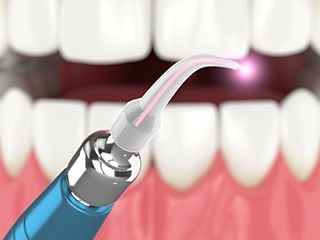
diode laserLasers direct a controlled force of energy that can remove or alter bone and tissue. By applying varying wavelengths of energy, dental lasers are used to detect and treat a myriad of oral health issues, including detecting oral cancer and treating small cavities.

There are two different types of dental lasers: hard tissue lasers and soft tissue lasers.

With unparalleled precision, hard tissue lasers emit a wavelength that can cut through bone, or more specifically, the calcium phosphate that make up our bones and teeth. The hard tissue laser eliminates the need for a dental drill, which is often associated with uncomfortable noise and vibrations.

Hard tissue lasers are typically used for:

  • Removing decay to a tooth for a filling
  • Detecting cavities under the gum line
  • Treating tooth sensitivity

Soft tissue lasers emit a wavelength that is easily absorbed by water and hemoglobin, a molecule found in the blood. Soft tissue lasers cut through soft tissue and seal exposed blood vessels at the same time, which is why laser treatments often have little bleeding and heal quickly.

Soft tissue lasers are typically used for:

  • Reshaping gums to lengthen crowns, or for cosmetic purposes, like treating a “gummy” smile
  • Making changes to soft tissue, like treating limited tongue movement or removing soft tissue that causes sleep apnea
  • Detecting abnormal tissue, like oral cancers
  • Treating infection in the root canal or gums

Lasers sterilize what they touch and seal any blood vessels they cut, which means dental lasers:

  • Reduce the need for sutures
  • Reduce the need for anesthesia
  • Reduce risk of infection
  • Reduce healing time significantly
  • Reduce blood loss during treatments
  • Educational Videos
  • Cosmetic & General Dentistry
  • Emergency Care
  • Endodontics
  • Implant Dentistry
  • Oral Health
  • Oral Hygiene
  • Oral Surgery
  • Orthodontics
  • Pediatric Dentistry
  • Periodontal Therapy
  • Technology

Contact Us

Send Us an Email

Error!

    Our Location

    Find us on the map

    Hours of Operation

    Our Regular Schedule

    Dentistry in the Beach

    Monday:

    10:00 am-7:00 pm

    Tuesday:

    8:00 am-5:00 pm

    Wednesday:

    8:00 am-5:00 pm

    Thursday:

    8:00 am-5:00 pm

    Friday:

    Administration Day

    Saturday:

    Closed

    Sunday:

    Closed

    • Copyright © 2026 MH Sub I, LLC dba Officite.
    • Admin Log In
    • Site Map