Would you like to switch to the accessible version of this site?

Go to accessible site Close modal window

Don't need the accessible version of this site?

Hide the accessibility button Close modal window
Accessibility View Close toolbar
Menu
  • Home
  • About Us
    • Meet the Dentist
    • Meet the Staff
    • FAQs
    • Office Tour
  • Our Services
    • Dental Examinations
    • Dental Implants
    • Restorative Dentistry
    • Teeth Whitening
  • Smile Gallery
    • Before & After Library
    • Testimonials
  • Insurance
  • Contact Us
  • Appointment Request
    • New Patient Forms
  • Patient Education
    • Dental Education Library
      • Oral Health Topics
      • Tooth Care
      • Dental Problems
      • Treatment
        • Cosmetic Dentistry
      • Pain Management
      • Patient Information
      • Product Reviews
      • Glossary
      • Links
  • General Dentistry
    • Bad Breathe
    • Braces
    • Brushing & Flossing
    • Cleaning & Polishing
    • Deep Scaling/Root Planing
    • Dental Examinations
    • Emergency Dental
      • What to do?
    • Family Dentistry
    • Gingivitis
    • Gum Disease
    • Prevention & Care
    • Teeth Sensitivity
    • Tooth Decay Prevention
    • Root Canals
    • Sealants
    • X-Rays
  • Pediatric Dentistry
    • Infants & Toddlers
      • Baby Teeth
      • Thumb Sucking
      • Baby Bottle Cavities
      • Teaching Children to Brush
    • Children & Teens
      • Getting Your Kids to Brush
      • Pulling Out a Loose Tooth
      • Favorite Foods & Cavities
      • Dental Anxiety
    • Emergency Dental
    • Dental4kids
      • Printable Games & Puzzles
      • Printable Coloring Pages
  • Cosmetic Dentistry
    • Dental Bonding
    • Dental Crowns
    • Dentures
    • Gum Recontouring
    • Invisalign
    • Porcelain Veneers
    • Smile Makeover
    • Tooth Whitening
    • Tooth Colored Fillings
  • Sedation Dentistry
    • Why Sedation Dentistry
    • Sedation Dentistry FAQs
    • Sedation Dentistry Types
  • Implant Dentistry
    • Dental Implants
    • FAQs on Dental Implants
    • Types of Implants
    • Why Choose Implants
  • Dental Problems
    • Dental Technology
    • Abscessed Tooth
    • Cavities
    • Dental Plaque
    • Dry Mouth
    • Fluorosis
    • Impacted Wisdom Teeth
    • Extractions/Wisdom Teeth
    • Maxillofacial Surgery
    • Oral Cancer
    • Toothache
    • Teeth Grinding
    • TMJ
  • Newsletter Library
  • Welcome Back Letter
Round Tooth Logo

(416) 694-8144

Our Locations
  • Home >
  • Articles >
  • Implant Dentistry >
  • Dental Implants

Dental Implants

  • Created in Implant Dentistry

dental implant

If you have recently dealt with an injury or disease that affected your oral health, there are options available to recover the smile you once had. You may even be able to achieve a better smile than the one you had. Dental implants make it possible to renew your smile if you have lost some teeth. There are several options when it comes to dental implants, depending on how many teeth need to be replaced: just one tooth or several teeth in a row.

How do dental implants work?

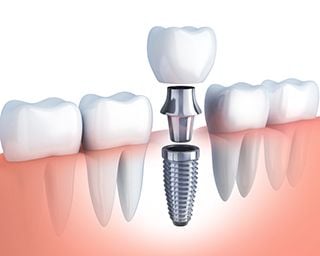
A dental implant is a metal post, usually made of titanium, which replaces the root portion of a missing tooth. Your dentist will then place a replacement tooth to the post, which can be permanently attached or removable. Permanent replacement teeth are more stable and feel more like natural teeth.

An ideal candidate for dental implants:

  • Is a non-smoker
  • Has maintained good oral health
  • Has healthy gums with no signs of gum disease

Single or Multiple Dental Implants
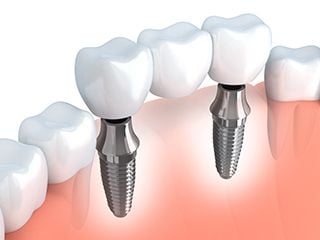
implant bridgeDental implants are very versatile. If you’re missing one tooth, one implant and one replacement tooth will take care of your problem. If you’re missing several teeth in a row, a few strategically placed implants can support a permanent bridge. Similarly, if you have lost all of your teeth, a full bridge or full denture can be permanently fixed in your mouth with a strategic number of implants.

Dental Implants vs. Dentures and Bridges

Unlike dental implants, bridges and dentures are not fixed to the bone. This can result in them being unstable, making it difficult to eat or smile with the confidence you want. Dental implants look, feel, and act more natural, just like your natural teeth. They also have a stronger biting force. Implants do not rely on neighboring teeth for support, which is definitely an advantage since this means they won’t compromise the health of your surrounding healthy teeth. Implants are also likely to last a lifetime, whereas bridges are only expected to last seven to ten years and even less if a root canal is required.

Taking Care of Your Dental Implants

Your new dental implants should be treated just like natural teeth. They require brushing and flossing at least twice every day and regular checkups and cleanings with your dentist. The better you take care of your implants, the more likely they truly will last you a lifetime.

  • Educational Videos
  • Cosmetic & General Dentistry
  • Emergency Care
  • Endodontics
  • Implant Dentistry
  • Oral Health
  • Oral Hygiene
  • Oral Surgery
  • Orthodontics
  • Pediatric Dentistry
  • Periodontal Therapy
  • Technology

Contact Us

Send Us an Email

Error!

    Our Location

    Find us on the map

    Hours of Operation

    Our Regular Schedule

    Dentistry in the Beach

    Monday:

    10:00 am-7:00 pm

    Tuesday:

    8:00 am-5:00 pm

    Wednesday:

    8:00 am-5:00 pm

    Thursday:

    8:00 am-5:00 pm

    Friday:

    Administration Day

    Saturday:

    Closed

    Sunday:

    Closed

    • Copyright © 2026 MH Sub I, LLC dba Officite.
    • Admin Log In
    • Site Map