Would you like to switch to the accessible version of this site?

Go to accessible site Close modal window

Don't need the accessible version of this site?

Hide the accessibility button Close modal window
Accessibility View Close toolbar
Menu
  • Home
  • About Us
    • Meet the Dentist
    • Meet the Staff
    • FAQs
    • Office Tour
  • Our Services
    • Dental Examinations
    • Dental Implants
    • Restorative Dentistry
    • Teeth Whitening
  • Smile Gallery
    • Before & After Library
    • Testimonials
  • Insurance
  • Contact Us
  • Appointment Request
    • New Patient Forms
  • Patient Education
    • Dental Education Library
      • Oral Health Topics
      • Tooth Care
      • Dental Problems
      • Treatment
        • Cosmetic Dentistry
      • Pain Management
      • Patient Information
      • Product Reviews
      • Glossary
      • Links
  • General Dentistry
    • Bad Breathe
    • Braces
    • Brushing & Flossing
    • Cleaning & Polishing
    • Deep Scaling/Root Planing
    • Dental Examinations
    • Emergency Dental
      • What to do?
    • Family Dentistry
    • Gingivitis
    • Gum Disease
    • Prevention & Care
    • Teeth Sensitivity
    • Tooth Decay Prevention
    • Root Canals
    • Sealants
    • X-Rays
  • Pediatric Dentistry
    • Infants & Toddlers
      • Baby Teeth
      • Thumb Sucking
      • Baby Bottle Cavities
      • Teaching Children to Brush
    • Children & Teens
      • Getting Your Kids to Brush
      • Pulling Out a Loose Tooth
      • Favorite Foods & Cavities
      • Dental Anxiety
    • Emergency Dental
    • Dental4kids
      • Printable Games & Puzzles
      • Printable Coloring Pages
  • Cosmetic Dentistry
    • Dental Bonding
    • Dental Crowns
    • Dentures
    • Gum Recontouring
    • Invisalign
    • Porcelain Veneers
    • Smile Makeover
    • Tooth Whitening
    • Tooth Colored Fillings
  • Sedation Dentistry
    • Why Sedation Dentistry
    • Sedation Dentistry FAQs
    • Sedation Dentistry Types
  • Implant Dentistry
    • Dental Implants
    • FAQs on Dental Implants
    • Types of Implants
    • Why Choose Implants
  • Dental Problems
    • Dental Technology
    • Abscessed Tooth
    • Cavities
    • Dental Plaque
    • Dry Mouth
    • Fluorosis
    • Impacted Wisdom Teeth
    • Extractions/Wisdom Teeth
    • Maxillofacial Surgery
    • Oral Cancer
    • Toothache
    • Teeth Grinding
    • TMJ
  • Newsletter Library
  • Welcome Back Letter
Round Tooth Logo

(416) 694-8144

Our Locations
  • Home >
  • Articles >
  • Cosmetic & General Dentistry >
  • Inlays and Onlays

Inlays and Onlays

  • Created in Cosmetic & General Dentistry

Inlays and onlays are indirect restorations used to repair molars and premolars damaged by decay or trauma. Inlays and onlays fit more securely and last longer than fillings, strengthen compromised teeth, and preserve more natural tooth structure than crowns.
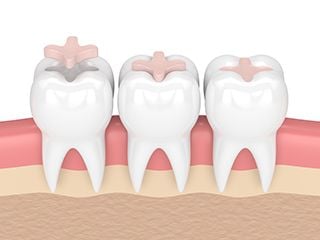
dental inlayAn inlay is used to restore the center of the tooth inside the cusps. Cavities, small cracks and fractures, and other damage are treated with an inlay when a large filling would weaken the structure of the tooth.
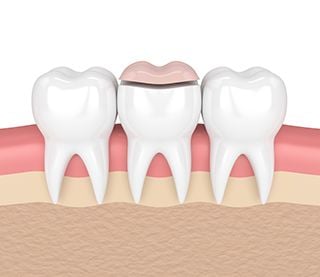
onlay

An onlay typically covers the center of the tooth and one or more cusps. An onlay prevents further cusp and tooth damage when a cusp is cracked, broken, or decayed. Because an onlay is placed only on the damaged part of the tooth, it is a less extensive procedure than a crown and preserves more of the natural tooth.

Direct restorations like dental fillings can be completed in a single appointment. Indirect restorations require at least two appointments, because the inlay or onlay is fabricated outside the office.

  • At the first appointment, the area is numbed, and the tooth treated for decay or injury. The tooth is then cleaned and shaped for the restoration.
  • An impression is taken of the tooth.
  • The tooth is given a temporary inlay or onlay to seal and protect it.
  • The impression is sent to a lab. Using this model, a restoration is carefully fabricated to fit the exact dimensions of the tooth.
  • Once the fabrication is complete, the temporary filling is removed, the permanent inlay or onlay is positioned for an ideal fit, and the restoration is bonded to the tooth surface.

In the past, gold was used for both inlays and onlays. Today, there are several options available to suit different aesthetic concerns and price points.

  • Gold restorations are fabricated from gold alloyed with other metals. While they are the most durable option, they are more expensive, and they can be conspicuous.
  • Ceramic and porcelain restorations are tinted to blend with tooth enamel and are both durable and stain resistant. They are roughly similar in cost to gold restorations.
  • Composite restorations are the most cost-effective option and are also tinted to match the tooth’s natural color. They aren’t as stain resistant as ceramic and porcelain and are slightly less malleable than other options.

When a tooth is too damaged for a filling, but doesn’t need the complete coverage a crown provides, an inlay or an onlay can be the ideal restoration. Talk to your dentist to discover the best option to restore both the appearance and the function of your injured tooth.

  • Educational Videos
  • Cosmetic & General Dentistry
  • Emergency Care
  • Endodontics
  • Implant Dentistry
  • Oral Health
  • Oral Hygiene
  • Oral Surgery
  • Orthodontics
  • Pediatric Dentistry
  • Periodontal Therapy
  • Technology

Contact Us

Send Us an Email

Error!

    Our Location

    Find us on the map

    Hours of Operation

    Our Regular Schedule

    Dentistry in the Beach

    Monday:

    10:00 am-7:00 pm

    Tuesday:

    8:00 am-5:00 pm

    Wednesday:

    8:00 am-5:00 pm

    Thursday:

    8:00 am-5:00 pm

    Friday:

    Administration Day

    Saturday:

    Closed

    Sunday:

    Closed

    • Copyright © 2026 MH Sub I, LLC dba Officite.
    • Admin Log In
    • Site Map